This blog is intended to be a discourse of reclaiming our social culture. It will study the need to re-claim our social culture that has been disintegrated, and displaced by the forces of corrupt governments, greedy corporations, money and power corrupt politicians, laisse faire economists, cynical academics, orientalist writers, facists, nationalists, communists, religious fanatics, secular extremists and ultra right-wing conservatives

Tuesday, June 20, 2006

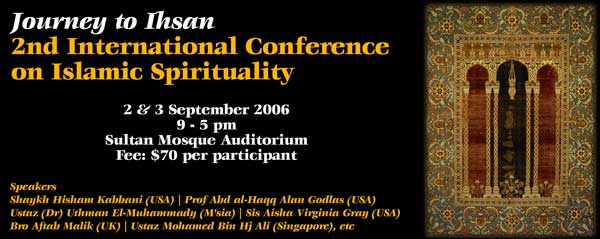
2nd International Conference on Islamic Spirituality

2nd International Conference on Islamic Spirituality


A good departure from the typical conferences held here in Singapore which tirelessly dwell upon contemporary discussions.

For the typical contemporary topics, the Muslim audience get to hear what they like to hear and it tends to be largely popular. But contemporary topics tend to be chiefly subjective which can be discussed till eternity without seeing an end or change. Likewise you cant see quite an observable impact or difference on the audience as they bring back little that which can truely enrich their lives.

In traditional topics like above, the audience can get to hear what is useful, resourceful, beneficial and helpful for them to hear where they can bring back something strong and useful which they can individually and privately work on.

A must go................... for info click ................ here

Tuesday, May 23, 2006

Inconsistent representation of the Muslim world

below are urls & thumbnails for pretty nice photos of mosques/shrines in pakistan taken by umair ghani. in the past, even nicer pics can be taken using colour saturated film and filters though it is a difficult and tedious process.today these photos are extremely a lot easier to do with digital photography though they are not as nice as slide photos. yet even today there are far few photos of the Muslim world and majority of the ones that are actually being taken are either orientalistic or post-modernistic.even this photographer spends only a fraction of his efforts on Islamic stuff.there is an vaccum for consistent representation of the Muslim world pictorally.


Shrine of Shah Rukan E Alam


Old Mosque


Drum Player at sufi shrine


Other Photos by Umair Ghani
http://photo.net/photodb/photo?photo_id=4342258
http://photo.net/photodb/photo?photo_id=2797276
http://photo.net/photodb/photo?photo_id=2785086
http://photo.net/photodb/photo?photo_id=4172909
http://photo.net/photodb/photo?photo_id=1872865
http://photo.net/photodb/photo?photo_id=1841174
http://photo.net/photodb/photo?photo_id=1584008
http://photo.net/photodb/photo?photo_id=1583975

Monday, March 06, 2006

How Are Cold Blooded Murderers Nurtured In A Society?

Social: How Are Cold Blooded Murderers Nurtured In A Society?

A year ago we discovered with horror of how a young girl, Huang Na, had been murdered in Pasir Panjang. Now we again come across another cold blooded murder of a child, Nonoi. The murderes in both murders were closely acquainted or related to the victims enough for the victims to trust them fully.

No murderer is born as one. He/she only grows up to be one. As a child or infant he/she is incapable of committing anything what they eventually end up committing. Hence there must be some form of transformation that transforms him/her into a beast capable of murder OR there must be something within us that if not controlled, will transform us into such a beast. Therefore we must realize there are negative environmental forces present within society that transforms one into a beast and/or there are positive environmental forces absent within society to prevent one from turning into a beast. Indeed it’s a combination of both the presence of these negative forces and absence of positive forces within a society that promotes the nurturing of such cold blood murderers. Therefore Singapore undeniably possesses such an environment enough to breed these two murderers. Singaporeans, who are averse to self-criticism, will deny vehemently and naively point out that if this assertion is true, why then every Singaporean is not a killer. Well this is a case of basket of apples. When they are left in a room with the inappropriate temperature and humidity, not every apple will rot but some definitely will.

When we have a few apples rot in a basket of apples, we throw away the rotten apples. That’s precisely what we do with our murderers. However we can do more. Even for apples we try to adjust the temperature and humidity to ensure no apple rots. Why aren’t we doing that for these beasts? It is easier for the institutions to look at them as rotten apples and just discard them than to complement those efforts by ensuring the apples don’t rot in the first place. Nothing can promise us that our apples in our basket will never rot should we control our temperature and humidity. Yet that element of uncertainty never damps our efforts. However when it comes to preventing humans within a society from turning into beasts, its always a different attitude and approach.

Religious institutions have a large role to play in this and secularism within a secular society remains a primary devil in stopping it. A secular society can never, as much as it can deny or proclaim otherwise, be able to develop ethics and virtues within each individual of society as effectively, efficiently and successfully as a religious society. Secularcrats can only be cynical to this statement and have produced nothing really empircally tangible to prove their ideals. Every secular society since the enlightenment age has a darker story to tell than their religious former. Secular societies tries in vain to promote ethics, virtues and good conduct through ethics boards, state run campaigns, propaganda etc etc but can never have even a fraction of the kind of impact that religious doctrines can. Even the coldest terrorists that we are seeing today are the fruits of secular societies using methodologies in their reasoning from secular societies. Societies based on religion have always been more humane and never saw such barbary. Even recent phenomenons of religion based societies which were trying frantically to reconstruct parallel to traditional religion based societies failed miserably only because they were more parallel to secular societies and were instead only pseudo-religious.

Educational institutions are another set of primary tools necessary to create a society that is incapable of nurturing beasts. That is where everyone of us spend up to a quarter of our life. That’s where you can nip the devil in us in the bud. Unfortunately our educational institutions from primary schools to universities here in Singapore function nothing more than as large tuition or teaching centers, tutoring kids to score good grades in examinations. Good conduct is paramount and supreme to good grades. But its not quite a prerogative but rather an ideal. Do teachers spend even half their time teaching good values? What’s the use of learning and understanding mathematical theory of equality without understanding the equality of mankind? I really wonder what schools these two beasts went to. I do know only one of them studied in Singapore. But Malaysian educational system is not too far different from Singapore’s. Theirs might not be as taxing but in Malaysian schools, just like in Singapore schools, is promoting good conduct, ethics virtues and values amongst students as central a mission as teaching kids how to read, write and pass exams?

Computerized, mechanized societies such as Singapore chant on the mantra of productivity. But how meaningful can a high level of productivity be when it wrecks the social well-being. The time one spends in office and with family is a natural tradeoff. Its pure shortsightedness of the capitalists because deteriorated social well-being will then in turn in long run affect future productivity.

When the space of an individual becomes too possessed by commercial culture through media, music, cinema etc, that person becomes bankrupt of emotions as he/she is de-sensitized to anything outside him/her realm and instead transforms into a selfish object. Money is like fire. Its only beneficial to us as a slave and not a master. When money is our slave, which happens when we give it no priority, then we are its master. When money is our master, which happens when we chase after it, then we are its slave. Building a society on money and material enslaves us to money and material which then burns our inner core away.

There are so many other forces present in our Singapore society that promotes the negative influences which transformed these two men into beasts .Likewise there are so many forces that prevents the existence of positive influences which protects these two men from turning into beasts. Indeed as a society we need to redefine our space in order to stop any forces that can nurture the growing up of individuals into cold blooded murderers.

Sunday, January 29, 2006

Do Singaporeans have culture?

Do Singaporeans have culture? (part I)

In the true Singaporean sense of ignorance, one of the least understood phenomenons is culture. Just as how Singaporeans love to simplistically define things, the word culture is also more than often defined so crudely to be something that involves arts, ethnicity etc. Though culture can be defined in many ways, a consistent definition will be as below
"What we mean by culture, is all the ways we as humans communicate with each other, whether we're producing culture by writing a poem or by building a community space where people are free to interact." (UBERCULTURE) http://www.uberculture.org/home/faq.html

When I pose the question whether Singaporeans have culture, I basically mean whether Singaporeans are able to interact with one another as humans. The sense of interaction involves all kinds of environments such as between colleagues within a work environment, with the spouse within a matrimonial union, with a fellow motorist on the road, with fellow passengers on a mrt/bus, between relations and kinsmen in the extended family and community, between neighbors in the neighborhood and between friends close and far, between customers and seller etc

The question “Do Singaporeans have culture?” is actually a generalized, qualitative question. Indeed the answer it will indeed be a generalized answer. Undeniably one can reasonably assert that the majority of Singaporeans have no culture i.e. Singaporeans are truly handicapped to interact with one another accordingly and positively as humans.

I am sure Singaporeans, being Singaporeans who are ultra-sensitive to self-criticism, will be defensive about this claim. They will deny in vain.

Indeed the rising divorce rates indicate some truths to the fact Singaporean couples are unable to interact positively and accordingly with their spouse as how humans rightfully ought to do. Boy-girl relationships are increasing failing as couples are increasingly unable to interact accordingly and positively with each other. In short in these aspects Singaporeans do lack culture. They lack the culture of being in a marriage or relationship.

The Chans in Everitt Road have demonstrated Singaporean are unable to interact positively and accordingly with their neighbors as humans. Indeed during my NS days, I have seen numerous Chans, who do exist in every neighborhood and increasingly increase nowadays. When I was growing up in the 1980s I was acquainted and well aware of each and every neighbor who resided along my long corridor. Today I have no clue who my next door neighbor who refuses to interact with me or anyone. Indeed nobody can deny that the old sense of neighborliness that used to exist in the neighborhoods are history today. The fundamental reason is nothing more than that Singaporeans lack the culture of being a neighbor.

The constant territorial and bloodbath ridden political struggles we hear and experience in Singapore work environments do demonstrate Singaporeans are unable to accordingly and positively interact with their colleagues as humans. Simple petty disputes are often blown out of proportion. Disagreements often tend to grow into conflicts. Conflict of opinions tend to deteriorate to misunderstandings. Arguments often tend to worsen to quarrels. Retaliation has become a common sense of response. Sabotage sometimes is used without hesitation to react to others. In short Singaporeans truly lack the culture of being a colleague.

Who can actually deny Singaporeans have great difficulty in having appropriate or positive interaction with their customers. Even the prime minister highlighted how Singaporeans lack the culture of providing service. In all the general problem is that Singaporeans are void of culture i.e. they are incapable of positive and appropriate interaction with others as humans.

Well lets look at the problem the other way. How can Singaporeans possibly have culture when they have never had any means to acquire it? They are handicapped because they lack the necessary skills and the sense of awareness that is necessary for them to practice effective and proper communication methods as humans. The fundamental cause of this is simply because what all Singaporeans have experienced as part of growing up, is rather only textbooks, malls, tv, computer and entertainment. These are insufficient and not the necessary mediums through which one comes into awareness or through which one develops the necessary skills. In other words we are like modern, advanced but primitive Man. What is necessary to cultivate a culture includes ethics, values, principles and understanding of emotions and reality all of which need the mediums of family, relatives, kinsmen, neighbors, priests and teachers to propagate. But isn’t everyone too busy working and trying to pay loans and bills? How then could Singaporeans learnt and acquired culture?

How did we end up here? Indeed there are many forces that have swept us into such detrimental stage. Firstly our education system. Does it really educate us or does it only teach us? Secondly how much of real, positive space in our early life do family, relatives, kinsmen, neighbors, priests and teachers occupy beyond the physical space? Thirdly, where in our society or country do we have conscientious understanding of this and what have we really done then or all along to avoid the predicament we are in now? Fourthly Singaporeans are so full of ego and kiasuism. Singaporeans live in a perpetual fear that the other person will beat them to something. Whenever they actually feel that way, their sense of ego kicks in forcing them to react adversely or defend passionately. Finally Singapore society has sold itself to materialism and capitalism till one inevitably stops seeing himself/herself collectively with others but instead starts to look at oneself alone only in a myopic and selfish way.

Hence these forces hinder Singaporeans from interacting accordingly and positively with one another as humans. What truly is disheartening is that Singaporeans were used to be known for their sense of culture. It was this sense of culture that promoted the masses to work hard and be focused in growth. Today the absence of culture within Singaporeans, is affecting the society in the socio-economic areas adversely. Focus, coordination and cooperation are rare. Instead it has deteriorated to a mad race, where each Singaporean is running faster and faster to catch up with yesterday.

Replacing family relations with money relations in a family

I was reading Karl Marx’s Communist Manifesto today on the bus. Even though I am anti-Communist, one need not be one or a sympathizer of communists to read that book. Indeed it is well accepted as an academic manuscript which is being used by many disciplines as it contains some relevant and useful theories.

One of the Marx’s theories is that when capitalism takes over the society, family relations will be replaced by money relations between family members.

This can never be truer than in Singapore which is one of the purest forms of capitalist society in the world. Indeed for Singapore to be a capitalist society, it needs to have the following key features.

Firstly the whole population must fall into two distinct classes that is defined by ownership of factors of production i.e. land, labor and capital. The bourgeois is the class that owns these factors of production. The proletariats are the one who sells their labor to the bourgeois. In a quasi-capitalist or non-capitalist, there will be more than these two classes or a single class. In the past when Singapore pursued socialist policies at least there were a few classes namely, the rich class comprising those who owned the factors of production, the middle class whose high literacy allowed them to sell their labor at a higher rate and a working class who had to depend on selling their labor at nominal rates.

Secondly in a capitalist society the question of what to produce is determined by pure profits. Hence where there exists positive externalities for society at large in utilization of certain goods and services and where its also not profitable, such goods and services will not be produced at all or at necessary levels. Likewise as to the question of for whom to produce, its purely determined by the ability to pay by consumer.

Thirdly in a capitalist society, competition is purely through price or more often market power. This is chiefly through extensive advertising campaigns, mergers, acquisitions etc.

Though these three features are not the only features to consider Singapore to be a capitalist society, they are indeed the key features. Moreover nobody quite denies Singapore today is a capitalist society. It is something that even some are proud of.

However as Marx pointed out, family relations today in Singapore is indeed being replaced by money relations between family members. The decision making process with regards to family is more than often dictated by the consideration of money. For instance money plays a very significant role or the most significant role in the decision making process when couples consider going into relationships, couples consider getting married, couples consider having a baby, couples consider having an additional baby, couples break up, children face the obligations of looking after their parents especially when they are very sick etc etc.

Traditionally family relations dictated money relations in family and was influenced by considerations, filial piety, sense of dedication, sentiments, morals, ethics, values and emotions. Today instead money relations dictate and is influenced by estimations of opportunity costs and benefits. Therefore in the earlier case, even when family is impoverished or limited in its resources(as in earlier days of Singapore), it was able to meet its wants and there was a positive and sustainable growth in the family aided by the force of the engine of family relations. Likewise in the latter case, even when family is affluent and has more than limited resources, family is unable to meet its needs and naturally declines and deteriorates.

It is disturbing for me to see the social transformation in Singapore in the last two decades. Back in the 80s where I grow up as a child, I saw the beauty of family relations amongst families that lived in my HDB block. It established and motivated the continuity of at least one economic driver, the breadwinner, who served the economic interests of the whole family unit. Family relations also established and motivated the continuity of at least one social driver who oversaw the social demands of the family unit. Family relations was always the underlying factor that trigger rehabilitation intervention or relief efforts whenever some member in the unit requires some form of rehabilitation or relief assistance. The same family relations often over flowed to the extended family, neighbors and community hereby having a macro effect on them.

The 90s boom in Singapore promoted the growth of capitalism and gradually replaced family relations with money relations. This was accelerated by the society’s desire for material prosperity and perpetual quest for 5Cs. However this transformation was a sub-conscious one to which today Singaporeans are waking up to realize.

Since Singapore is at the cross roads of development sitting on the fence of an industrialized economy and facing the prospects of possibly growing into a developed economy or stagnating into a less developing economy, it still has time to put its house on order. Indeed it is still not too late to replaces the very forces, which eroded family relations and replaced it with money relations, such as secularism, westernization and capitalism with spirituality, culture, traditions and ethics.

What is a loss?

Recently the Russel Crowe of Indian cinema, Kamal Hasan, was giving an interview to Vasantham Central. He generally makes two movies per year where one is commercial and the other is art/independent. He invests a lot for the latter and more than often it fails commercially. He simply however never gives up. He believes in making good and different ones and so he keeps spending a lot for which no commerical producer wants to invest.

Everyone always asks the same question to him. How can you bear all the huge money loss you have been incurring almost each year?

He gave an excellent answer as to what is loss....

He was explaining that loss is something that which you cannot gain back. In terms of money, if you loose it today, you can gain it back tomorrow if you work hard and smart enough... He further explained that even friendship and kinship when lost can be gained back with a sorry. However he asserted that, what that which you loose today and CANNOT gain back tomorrow, which will then amount to loss, will include life, youth etc....

Growing up in Singapore, I was always so fearful of failing my exams cos i thought and was told (by educational system) it was the end of everything. But as i matured i realized i can afford to fail and pass the following year. Though i didnt fail the exams in primary or secondary or jc, I regret stressing myself excessively before the exams.

Likewise when i decided to take year out to try something different, there were criticisms of how i will loose out. What i went to try didnt succeed as I wanted to, but hey i am able to return to what i was doing before. What i am loosing out is money, which I can make back if i try harder and smarter. Every loss and success comes from Al-Mighty. We just need to try...

Being Equal and Being Identical

I read with great dismay about how a condominium management and residents opted to have non-Indian security guards. What really disgusts me is that how openly they can actually demonstrate their prejudice. Perhaps its just a spillover of the racism bottled within the Singapore society.

I am a minority by race, language and religion in this country and till today almost everyday I feel I am like a nigger in a white man's society being subject to all kinds of prejudice. But when i take a closer look I find that the racism that envelopes this Singaporean society is not just about ethnicity whereby the majority ethnic groups discriminate the minority ethnic groups. Instead I have come across numerous friends who are Chinese but Pernakan in heritage or mixed in parentage or English speaking etc and hence they face prejudice and discrimination for being that slightly different.

I believe I can sum up the racism in Singapore to be that where one is discriminated when he/she is not fitting the "mould" or "norm". This is partly thanks to the great effort that is being to put to ensure everyone is identical. This in turn stems from the flawed belief that if we, a multiracial society, can be identical in outlook and nature then we can live in harmony and avert racial problems. Even identical twins are not exactly identical because they differ in character, tastes, etc etc. Hence it is not possible for two humans to be identical. Instead humans are a diverse creation. They differ in numerous ways. However they are equal. Where one person is advantaged over another person in something, he/she will be disadvantaged over the other person in another thing. This is the reality of creation of Mankind.

Though the Singapore society's ends to achieve racial harmony is valid and respectable, its means by making sure everyone is identical is fundamentally and logically flawed.

Gambling is a Vice, Casinos are Institutions of Vice

Contemporary bloggers may find this old topic, but i am not concerned about it.
The proponents of the casino have informed that the commerical benefit of opening two casinos is greater than the ills that can be managed.

What i will like to ask is this.... Isnt gambling a vice? Isnt casino an institution of vice? Hence should the arguments for gambling be accepted, they can also be used to justify other vice activities. How about starting a giant red light area or a drug hub? We can use the necessary experts to manage the ills. Furthermore it will bring more commercial benefit than casinos. Also our Singaporeans are already flocking to thailand and batam for sex and drugs. Should we one day wake up to find our brothels and drug pushers second class to that of our neighbours?

Once we allow cynicism into our policy making, it will cloud wisdom and judgement. Secondly how much we may deny, gambling indeed is a vice and casinos are institutions of vice.